- Magnetic Therapy Devices Deals
- sku: 1010580930974753
- TOPONECHOICE TMS-81806
TMS-81806 TOPONECHOICE Transcranial Magnetic Stimulation
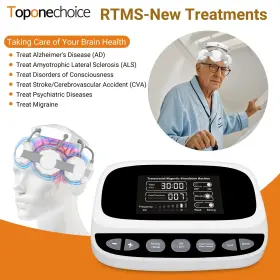
| Brand | TOPONECHOICE |
|---|---|
| Manufacturer Part Number | TMS-81806 |
| Main Purpose | PARKINSON, BRAIN STROKE DEMENTIA, ALZHEIMERS DISEASE AD, DISORDERS OF CONSCIOUSNESS, STROKE, MIGRAINE, AUTISM, CHRONIC NEUROPATHIC PAIN, MOTOR DISEASE, PSYCHIATRIC DISEASE, AMYOTROPHIC LATERAL SCLEROSIS |
| Variable Frequency Modes | 11 MODES TO CHOOSE |
| Magnetic Field Frequency | 1/5/10/15/20/30/40/50HZ, 8 FIXED FREQUENCY ADJUSTABLE |
| Working Voltage | AC 110V-240V, 50HZ/60HZ |
| Color | WHITE BLACK |
| Time | 0-95 MINUTES, EVERY 5 MINUTES ADJUSTABLE |
| Material | ABS |
| Head Vibration Mde | AVAILABLE |
| Weak Level Magnetic Strength | 6MT-10MT |
| Type | STIMULATION DEVICE |
| Department | MEN, UNISEX, WOMEN |
| Number Of Therapeutic Heads | 1 LARGE THERAPEUTIC HEAD 8 SMALL THERAPEUTIC HEAD |
| Unit Type | UNIT |
| Manufacturer Warranty | 1 YEAR |
| Features | ADJUSTABLE, PORTABLE, PRACTICAL TO USE |
| Country/region Of Manufacture | CHINA |
| Strong Level Magnetic Strength | 11MT-19MT |
| Net Weight | 1KG/2.21 LBS |
Review TOPONECHOICE Tms Transcranial Magnetic Stimulation Therapy For Older People Improve Sleep
TMS-81806 Transcranial Magnetic Stimulation Therapy Device for Improving Sleep
The TMS-81806 Transcranial Magnetic Stimulation (TMS) therapy device is a state-of-the-art non-invasive solution designed to help individuals improve their sleep quality. This innovative medical device harnesses the power of magnetic fields to stimulate specific areas of the brain, promoting better sleep patterns and overall restorative rest.
The TMS-81806 device is compact and portable, making it an ideal choice for those seeking convenient and flexible therapy options. It features a comfortable and adjustable headgear, ensuring a secure and snug fit during treatment sessions. The headgear is equipped with coils strategically placed to target key areas in the brain responsible for regulating sleep and wake cycles.
Each treatment session with the TMS-81806 device lasts approximately 20 minutes, and the therapy is typically administered five days a week for several weeks. During the session, an individual will feel gentle tapping sensations on their scalp as the magnetic fields are applied. These sensations are a normal part of the treatment process and usually subside quickly.
The TMS-81806 device is FDA-cleared and non-invasive, meaning it does not require surgery or the use of anesthesia. It is also drug-free, making it an excellent alternative for individuals who prefer not to rely on medication to manage their sleep issues.
Studies have shown that TMS therapy can be effective in improving sleep quality in individuals with various sleep disorders, including primary insomnia, sleep apnea, and restless legs syndrome. The therapy may also help individuals with depression, anxiety, and other conditions that impact sleep.
The TMS-81806 device is easy to use and can be administered by a healthcare professional or under their supervision. It is important to note that TMS therapy should not be used as a replacement for professional medical advice, diagnosis, or treatment.
In summary, the TMS-81806 Transcranial Magnetic Stimulation therapy device is a safe, effective, and non-invasive solution for individuals seeking to improve their sleep quality. It is a convenient and portable option that can be administered in the comfort of one's own home or under the supervision of a healthcare professional. With its innovative technology and proven effectiveness, the TMS-81806 device is an excellent choice for anyone looking to enhance their overall sleep health.
Transcranial Magnetic Stimulation (TMS) therapy, including the TMS-8180 model from TMS Health Solutions, is a non-invasive neurostimulation treatment that has been approved by the U.S. Food and Drug Administration (FDA) for various conditions, including major depressive disorder. However, it is also gaining attention for its potential in improving sleep quality. Here are some pros and cons of using TMS therapy for sleep improvement.
Pros:1. Non-invasive: TMS therapy does not require surgery or the use of medications, making it a less invasive option compared to other sleep treatments.
2. Targeted: TMS therapy directly stimulates specific areas of the brain involved in sleep regulation, potentially leading to more effective results than oral sleep medications.
3. Customizable: TMS therapy can be tailored to the individual's specific needs, as the intensity, frequency, and duration of stimulation can be adjusted based on their response.
4. Few side effects: TMS therapy typically has fewer side effects compared to oral sleep medications. Common side effects include headaches, scalp discomfort, and muscle twitches, which are usually mild and temporary.
5. Long-term effects: Some studies suggest that TMS therapy may have long-lasting effects on sleep quality, even after the treatment sessions have ended.
Cons:1. Cost: TMS therapy can be quite expensive, with each session costing anywhere from $100 to $500 or more, depending on the location and provider.
2. Insurance coverage: Not all insurance plans cover TMS therapy for sleep improvement, which can make it an unaffordable option for some individuals.
3. Limited availability: TMS therapy for sleep improvement is not widely available, and it may not be offered at all clinics or healthcare facilities.
4. Limited research: While there is some evidence to suggest that TMS therapy can improve sleep quality, more research is needed to fully understand its effectiveness and long-term benefits.
5. Time commitment: TMS therapy typically requires multiple sessions over several weeks to achieve the desired results, which can be a significant time commitment.
In conclusion, TMS therapy, including the TMS-8180 model, can be an effective, non-invasive treatment option for improving sleep quality. However, its high cost, limited availability, and the need for multiple sessions make it a less accessible choice for many individuals. If you are considering TMS therapy for sleep improvement, be sure to discuss the potential benefits and risks with your healthcare provider to determine whether it is the right option for you.
Recommendation: If you are experiencing significant sleep problems and have tried other treatments without success, TMS therapy may be worth considering. However, be prepared for the potential costs and time commitment involved. It's also important to discuss the risks and benefits with your healthcare provider before making a decision. Other options to improve sleep, such as lifestyle changes, relaxation techniques, and oral sleep medications, may be more accessible and cost-effective.
Details:
Default us plug. Application of transcranial magnetic stimulation therapy RMS treatment is a painless, non-invasive, and no side effect method. 1, trans magnetic stimulation can treat alzheimer stroke disease; 2, treat motor diseases Parkinson's disease ; 3, alleviate psychiatric diseases, such as depression, anxiety; 4, relieve chronic neuropathic pain; 5, improve amyotrophic lateral sclerosis, multiple sclerosis; 6, disorders of consciousness.
P principle -transcranial magnetic stimulation is a non-invasive form of brain that uses changing Fields to induce electrical currents in specific areas the through electromagnetic induction. Transcranial magnetic stimulation therapy. Vegetative state or minimally conscious. Tms demonstrates diagnostic and therapeutic potential in the centurions system, can be used to treat various disease states Fields of neurology and mental health.
Package details of tms therapy treatment safe and effective. Insomnia, Parkinson's disease, paralysis, brain atrophy, schizophrenia, depression, anxiety, hyperactivity disorder, neurasthenia, stroke, autism, delusions, cerebral infarction. Principle of tms treatment transcranial magnetic stimulation outputs specific regular alternating electromagnetic field to act on brain cells and cerebral blood vessels in order change the metabolic environment lesion area, so that enzyme activity involved metabolism is increased. Magnetic has the characteristics of light weight, small volume, applicable to people with different head circumference and comfortable wear.
The transcranial magnetic brain stimulation is recommend 20-30min each time, 5 times a week, continuously for 6-8 weeks or more. Multi-functions of RMS therapy transcranial magnetic treatment has 8 fixed frequency modes: 1/5/10/15/20/30/40/50hz, adjustable; trans magnetic stimulation therapy 11 conversion modes to choose from; field strength transcranial can be optional: strong 11mt-19mt, weak 6mt-10mt ; shock, no shock optional; time: 0-95 minutes, adjustable.
specifications magtherapydev:
- brand: Toponechoice
- mpn: Tms-81806
- main purpose: Parkinson, Brain Stroke Dementia, Alzheimers Disease Ad, Disorders Of Consciousness, Stroke, Migraine, Autism, Chronic Neuropathic Pain, Motor Disease, Psychiatric Disease, Amyotrophic Lateral Sclerosis
- variable frequency modes: 11 Modes To Choose
- magnetic field frequency: 1/5/10/15/20/30/40/50hz, 8 Fixed Frequency Adjustable
- working voltage: Ac 110v-240v, 50hz/60hz
- color: White Black
- time: 0-95 Minutes, Every 5 Minutes Adjustable
- material: Abs
- head vibration mde: Available
- weak level magnetic strength: 6mt-10mt
- type: Stimulation Device
- department: Men, Unisex, Women
- number of therapeutic heads: 1 Large Therapeutic Head 8 Small Therapeutic Head
- unit type: Unit
- manufacturer warranty: 1 Year
- features: Adjustable, Portable, Practical To Use
- country/region of manufacture: China
- strong level magnetic strength: 11mt-19mt
- net weight: 1kg/2.21 Lbs
offer magtherapydev:
- quantity: 1
- options: ship-to-home
- availability: in stock
- started: august 18, 2025
- best offers: true
- sold #: 17
returns magtherapydev:
- paid by: buyer
- time: 30 days
- method: money back
- policy: returns accepted
seller magtherapydev:
- # reviews: 24
- rating: 100.0%
- city: ana, california
shipping magtherapydev:
- type: fixed
- service: standard
- transit: 3-8 days
- class: standard
general magtherapydev:
- category: Health & Beauty > Natural Alternative Remedies > Magnetic Therapy
payments magtherapydev:
- other
- credit card: diners-club
- wallet: google-pay
Similar Items:
- Toponechoice Jlc-50610 Rechargeable Tms Therapy Machine At Home And Clinic Use For Parkinson Stroke Vegetative state or minimally conscious. Principle transcranial magnetic stimulation is a non-invasive form of brain that uses changing Fields to induce electrical currents in specific areas the through electromagnetic induction. Parkinson's disease ; 3, alleviate psychiatric diseases, such as ...(May 6th, 2025)
- Toponechoice Jlc-50609 Portable Tms Device For Stress Relief And Brain Energy Home Clinic Use Multi-functions of RMS therapy transcranial magnetic treatment has 8 fixed frequency modes: 1/5/10/15/20/30/40/50HZ, adjustable; trans magnetic stimulation therapy 11 conversion modes to choose from; field strength transcranial can be optional: strong 11MT-19MT, weak 6MT-10MT ; shock, no shock ...(May 6th, 2025)
- Toponechoice Jlc-50608 Transcranial Magnetic Stimulation For Cognitive Function Support Improve Sleep Magnetic has the characteristics of light weight, small volume, applicable to people with different head circumference and comfortable wear. The transcranial magnetic brain stimulation is recommend 20-30MIN each time, 5 times a week, continuously for 6-8 weeks or more. Parkinson's disease ; 3, ...(May 6th, 2025)
- Toponechoice Jlc-50607 Rtms Stimulator For Mental Clarity And Focus Enhancement Tms Magnetic Treatment The transcranial magnetic brain stimulation is recommend 20-30MIN each time, 5 times a week, continuously for 6-8 weeks or more. Transcranial magnetic stimulation therapy. Multi-functions of RMS therapy transcranial magnetic treatment has 8 fixed frequency modes: 1/5/10/15/20/30/40/50HZ, adjustable...(May 6th, 2025)
- Toponechoice Jlc-50606 Tms Therapy Device For Emotional Balance And Relaxation Magnetic Treatment Default us plug. Vegetative state or minimally conscious. Insomnia, Parkinson's disease, paralysis, brain atrophy, schizophrenia, depression, anxiety, hyperactivity disorder, neurasthenia, stroke, autism, delusions, cerebral infarction. Principle of tms treatment transcranial magnetic stimulation ...(May 6th, 2025)
- Toponechoice Jlc-50605 Fda-cleared Tms Machine For Neurological And Mood Support Depression Tms demonstrates diagnostic and therapeutic potential in the centurions system, can be used to treat various disease states Fields of neurology and mental health. Parkinson's disease ; 3, alleviate psychiatric diseases, such as depression, anxiety; 4, relieve chronic neuropathic pain; 5, improve ...(May 6th, 2025)
- Toponechoice Jlc-50604 Non-invasive Magnetic Brain Stimulator For Cognitive Support Depression 1, trans magnetic stimulation can treat alzheimer stroke disease; 2, treat motor diseases principle of tms treatment transcranial magnetic stimulation outputs specific regular alternating electromagnetic field to act on brain cells and cerebral blood vessels in order change the metabolic environment...(May 6th, 2025)
- Toponechoice Jlc-50603 Repetitive Tms Rtms Device With Adjustable Frequency Settings For Parkinson Multi-functions of RMS therapy transcranial magnetic treatment has 8 fixed frequency modes: 1/5/10/15/20/30/40/50HZ, adjustable; trans magnetic stimulation therapy 11 conversion modes to choose from; field strength transcranial can be optional: strong 11MT-19MT, weak 6MT-10MT ; shock, no shock ...(May 6th, 2025)
- Toponechoice Jlc-50602 Medical Grade Transcranial Magnetic Stimulator At Home Use For Parkinson Application of transcranial magnetic stimulation therapy RMS treatment is a painless, non-invasive, and no side effect method. Insomnia, Parkinson's disease, paralysis, brain atrophy, schizophrenia, depression, anxiety, hyperactivity disorder, neurasthenia, stroke, autism, delusions, cerebral ...(May 6th, 2025)
- Toponechoice Jlc-50601 Tms Therapy Device For Brain Stimulation And Mental Wellness Support Stroke Insomnia, Parkinson's disease, paralysis, brain atrophy, schizophrenia, depression, anxiety, hyperactivity disorder, neurasthenia, stroke, autism, delusions, cerebral infarction. Principle-transcranial magnetic stimulation is a non-invasive form of brain that uses changing Fields to induce ...(May 6th, 2025)
- Toponechoice Tms-81807 Tms Treatment For Depression Transcranial Magnetic Stimulation Migraines Principle transcranial magnetic stimulation is a non-invasive form of brain that uses changing Fields to induce electrical currents in specific areas the through electromagnetic induction. The transcranial magnetic brain stimulation is recommend 20-30MIN each time, 5 times a week, continuously for 6...(August 18th, 2025)
